thinkoholic.com - a blog by markus nolf

Archive for the 'nature' Category

[posted: Tuesday, 10.06.2008 at 20:33] [category: nature, photo]

greetings from scheffau, austria.
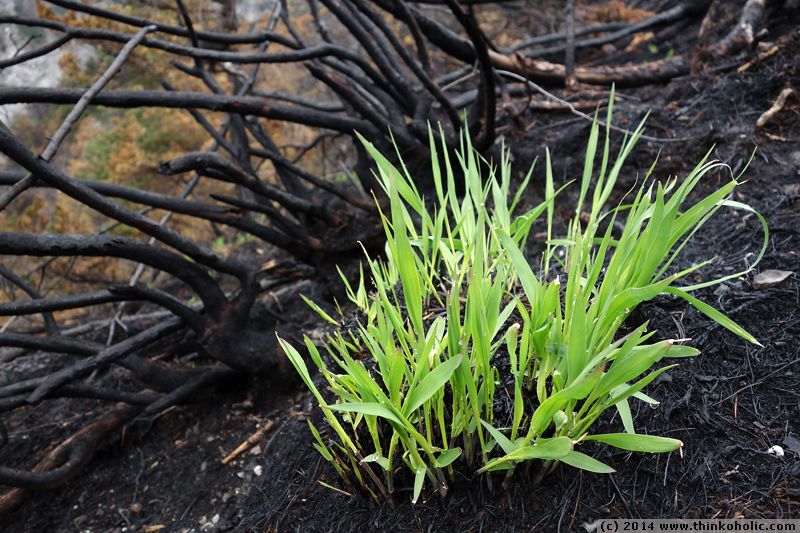
i spent the day in the forests of the region for a work-related project, and found this:

wood-horsetail (equisetum sylvaticum)
wood-horsetail (equisetum sylvaticum; wald-schachtelhalm)

it’s a relatively unspectacular plant, i know, but when i came across a small patch of those in an uphill direction, i saw all the plants laterally, their worls as parallel discs, one hovering above another.

[posted: Thursday, 24.04.2008 at 22:36] [category: nature]

great news from one of the rarest animals in the world:

Seven kakapo chicks that hatched just over two weeks ago on Whenua Hou (Codfish Island) have been transferred to specialised facilities in Nelson to ensure their survival, Conservation Minister, Steve Chadwick announced today.

“I am thrilled with this season’s kakapo breeding success. The safe arrival of these chicks brings the total kakapo population to 92 and is testament to the dedication of the Department of Conservation in ensuring that these ancient and critically endangered birds continue to survive,” Steve Chadwick said.

...

Kakapo last bred in 2005 when four chicks were produced, but the record year was in 2002 with 24 chicks.

 
source: kakapo chicks relocate to maximise survival
 

the ranger’s diaries, a relatively new feature over at the official kakapo website, provide a little insight into the day-to-day ongoings:

Safely ensconced in their new Nelson facility, the birds have been enjoying a routine of four-hourly feeds starting at 7 in the morning and finishing at 11 at night. They are doing well and making good weight gains; several of them have now hit 500 grams and are getting quite large and feisty at feed time!

 
source: Kakapo Ranger’s Diaries: Hot chicks in the city
 

see also: kakapo-related blog posts at thinkoholic.com (including photos)

[posted: Wednesday, 16.04.2008 at 22:59] [category: nature, photo, time-lapse]

the following video provides a close-up view of the the development of 5 frog embryos.
11 days in 66 seconds:

more information on the making of this time-lapse video: [more...]

[posted: Friday, 11.04.2008 at 23:33] [category: nature]
young kakapo chick, tv3 screenshot

great news for one of the most endangered bird species of the planet:

In the last two weeks, five kakapo chicks have hatched with another two due to arrive in the coming fortnight.

While seven may seem a meagre birth-rate, it’s big news for a bird that has battled back from the brink of extinction.

The births are the culmination of an extensive recovery programme launched by the Conservation Department, after research expeditions discovered that numbers had slumped to 51 kakapo in 1995.

Kakapo recovery team leader Emma Neill said "boosting the population from 86 to 91 is awesome especially considering these birds only breed every few years".

source: five an ‘awesome’ boost to kakapo pop, stuff.co.nz

video clips:

[posted: Sunday, 06.04.2008 at 23:26] [category: nature, photo]
romanesco (brassica oleracea)

i laid my hands on romanesco - and couldn’t give it away before i had taken some photos of it.
if you know what this vegetable looks like, you might be able to understand why:
romanesco is a variant form of cauliflower (brassica oleracea var. botrytis), looks more like broccoli in its general shape and colour, but has one amazing feature: its flower buds exhibit a high level of self-similarity.
each little "bud cone" is made up by lots of smaller cones - they are fractal spirals (romanesco is sometimes called "fractal broccoli").
furthermore, the number of cones in each spiral is part of the fibonacci sequence.

very well-suited to stare at in amazement ;-)

[view photos: romanesco ]

[posted: Tuesday, 25.03.2008 at 01:34] [category: bats, photo]
skeleton of a greater mouse-eared bat (myotis myotis)

i’ve prepared a few photos of a bat skeleton from last summer.
it’s a preparation of a greater mouse-eared bat (myotis myotis, grosses mausohr), that i received for a bat presentation. it had been used for demonstration purposes for a long time, so the ribcage is damaged.

i think it’s fascinating to actually "trace back" their evolution and see how over time, the fingers were prolonged, connected with skin (similar to the webbed toes of a duck) and made into wings.
the photos also show that these little creatures adhere to the basic "blueprint" of all mammals.
 

[view photos: bat skeleton]

[posted: Monday, 17.03.2008 at 01:44] [category: nature, photo, time-lapse]

rainfall is very rare in the desert - that’s why many species of desert plant have developed special mechanisms that help them to increase the offspring’s chances of survival.

cheiridopsis sp. (family aizoaceae) is one of these species: it has dry woody fruits that protect the seeds during dry periods.
when it starts to rain - sometimes it takes years from one rainfall to another - time is of the essence: as soon as a drop of rain lands on the capsules, they absorb the water and hydrostatic pressure opens them.
within minutes, seeds are released onto humid ground and find a good base to germinate.

while in south africa last september, i tried it myself: a drop of water sufficed, and the seed capsule was completely open just 10 minutes later.

cheiridopsis sp. seed capsule

i’ve also created an animated time-lapse gif that shows the process: [more...]


all photos | alle photos